At Richer Resources, we are dedicated to the creation of high quality books, art and other media intended to enrich the lives of individuals of all ages.
As an independent publisher, we are bound by a sense of integrity and quality to produce products which enhance the lives and vision of individuals everywhere.
Sign up to receive notice of free eBooks, new releases and special subscriber-only offers.
(You can unsubscribe at any time)
| Homer's Tomb |
 |
|
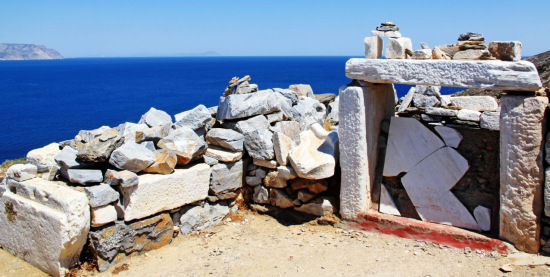
Has Homer's Tomb been found in Ios, Greece?
Homer is among the most frequently
talked about authors over all of human
history and myth more than facts
surround his life and death. If, indeed,
Homer did exist, there are numerous
theories about who he was, when he
lived, where he was born and how and
where he died. One ending to Homer's
life says that he died of old age at
around the age of 99, settling there
since it was the home of his mother.
Another story is that he had an
accident, fell ill or was killed after
failing to solve a riddle given him by a
group of young boys during a trip to Ios
and that his body was taken there for
burial after he died. One thing is
certain, and that is there is as much
myth surrounding Homer's death as there
is around his life and the stories he
wove. |
| __________________________________________________________________________________ |
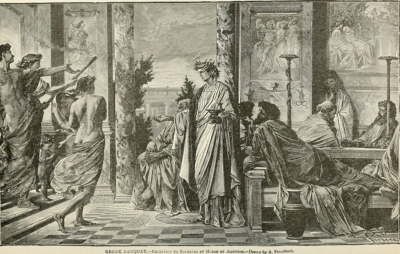
| It is interesting to think of Aristophanes as being as much a reporter or opinion writer as a dramatist, because of his ability to freely communicate his political opinions in the play. |
 |
|
First produced in 423 BC at the City Dionysia theater festival, Aristophanes’ Clouds is often considered one of the world’s first comedies of ideas—a sort of “Saturday Night Live” political satire. The play is, however, unusually serious for an “Old Comedy,” as comedies of this period are known, and perhaps for that reason was not well received at first. Athens was looking for peace in the ongoing Peloponnesian War, and Aristophanes provided a distraction, turning his attention to such issues as the sorry state of education in Athens and the recurring battle between so-called old and new ideas. The playwright’s main target is Socrates, who is lampooned as a petty thief, a fraud, and an arch sophist. Clouds introduced Socrates on the stage of world literature, and Plato appears to have considered the play a contributing factor in the philosopher’s trial and execution in 399 BC. Despite the play’s poor reception initially, it remains one of the most famous and popular Greek comedies, containing some of the finest specimens we have of lyric poetry. It is interesting to think of Aristophanes as being as much a reporter or opinion writer as a dramatist, because of his ability to freely communicate his political opinions in the play. Ian Johnston’s translation of Clouds brings both the lyricism and the humor of the original to today’s audiences. |
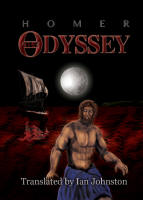
The Odyssey tells the story of famous Odysseus, hero of ancient Greece, and his 20 year wandering return from the Trojan War. Beset by heartache and diversion, Odysseus' story is one of adventure, glory and despair of one man's determination to return home and of the times in which he lived. Timeless in the telling, it depicts an age when mythology and truth merged into reality in literary form...more
____________________________
The comic drama Clouds (423 BC) is one of the most famous and popular satires ever written. In it Aristophanes, the greatest comic dramatist of ancient times, takes issue with the intellectual and moral depravity of his fellow Athenians, particularly with their thirst for radical innovations in traditional ways of thinking and for their unscrupulous self-interest. The play is particularly famous for its portrayal of Socrates, the target of much of the very robust satire...more

When the future meets the past:
The Lycurgus Cup
 |
The Lycurgus Cup is a glass chalice dating to 4th century Rome made of dichroic glass (glass which shows different colors when viewed from different directions.) It appears red when lit from behind, but green when lit from the front...read article here...